Corporate Event Planning: Email Sequences for Pre-Event Nurturing and Post-Event Re-engagement
Jump To Section
- Customisable RSVP Forms: Capturing the Right Attendee Data from the Start
- Automated QR Code Generation: Reducing Friction Between Registration and Arrival
- On-Site QR Scanning, Check-In and Name Tag Printing: Eliminating Queues on Event Day
- Real-Time Dashboard and Attendee Tracking: Full Visibility Before, During, and After
Key Insights:
- Live attendance across the industry runs between 44% and 50% of registrations, which places more of the attendance burden on the reminder sequence than on the promotional campaign preceding it.
- Announcement emails perform better when they are opened with the decision an attendee will be equipped to make, with date, venue and agenda following once interest has been established.
- Singapore’s Do Not Call Registry covers voice calls, text messages and fax but not email, although event mailing lists remain subject to the PDPA’s consent and withdrawal obligations.
Corporate event budgets in Singapore are increasingly assessed on attendance, and the distance between registration numbers and the people in the room has become the figure that decides whether an event is judged successful. That gap is seldom created by the venue, the programme or the speaker line-up. It opens weeks earlier, inside an email schedule that stopped at the registration confirmation and resumed only after the event had passed.
Email remains the most dependable channel available to corporate event planning teams because it is the only one an organisation owns outright. Organic social reach depends on more on a platform’s algorithm, and paid promotion ceases the moment a budget is exhausted. A maintained list carries forward from one event to the next and grows more valuable as the behavioural data behind it accumulates.
Handled properly, the programme around a corporate event is four distinct sequences: the announcement, the reminders in the final week, the follow-up immediately afterwards, and the longer nurture that keeps an audience warm until the next announcement. Each has a different job and a different measure of success. We examine all four, together with the benchmarks that indicate whether each is working.
Email Announcements: Value Proposition Before Logistics

The announcement carries a burden no later message shares, in that it has to generate interest where none existed. Every email after it addresses an audience which has already committed something, even if only attention. Most announcements weaken themselves at the first line by opening with logistics, presenting a date and a registration link before establishing why it should matter to a manager with a full diary.
A stronger construction leads with the outcome, identifying what an attendee will be equipped to decide or resolve afterwards, and naming two or three sessions alongside the problem each address. Date, format and location follow once that case is made. Industry open rates sit near 19% with click rates near 2.4%, so an announcement competes for a narrow slice of attention and one clear proposition outperforms three.
Early bird pricing remains effective in the Singapore market, although its value depends entirely on the deadline being observed. An organiser who extends a published deadline twice teaches the list that deadlines are decorative, and the effect carries into every subsequent campaign. A well-constructed announcement typically contains four elements:
- A single-sentence proposition that proves the events value to the user
- Two or three named sessions or speakers, each tied to a specific problem and solution
- Clear mention of the event date, format and location
- A call to action pointing to a registration page that loads quickly on mobile
Send timing r
Executing the Event Reminder Sequence
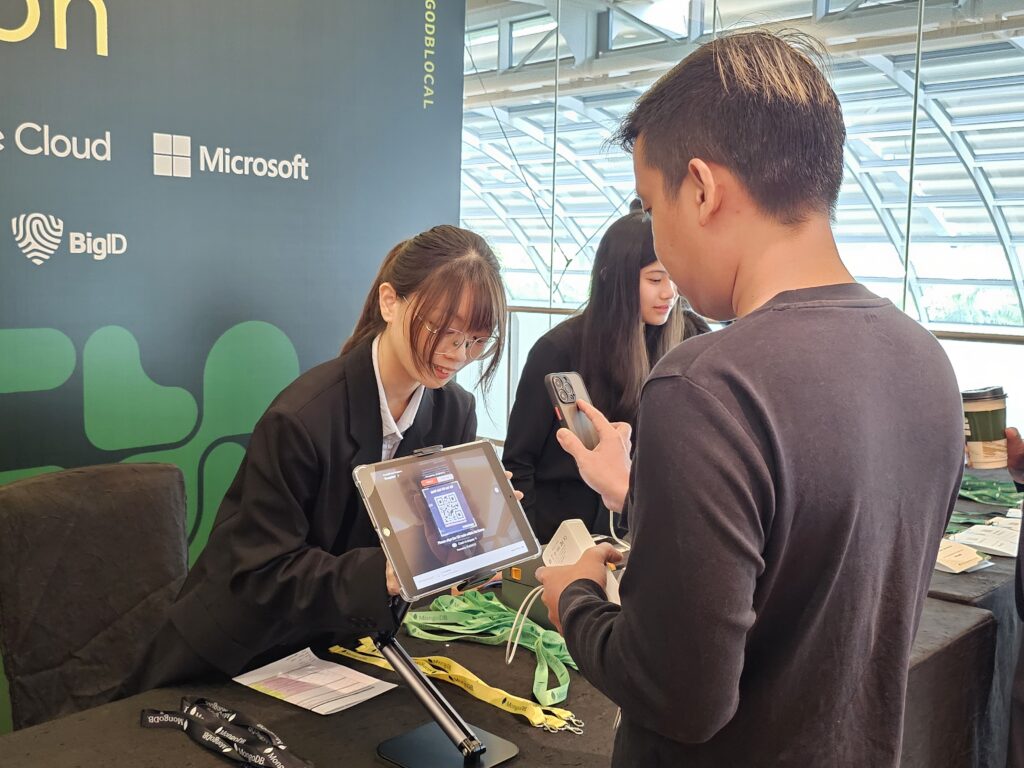
Registration records intent while attendance records commitment, and the distance between them is wider than most organisers assume. Benchmark data drawn from more than a million registrants places live attendance between 44% and 50%, with Tuesday sessions at the upper end and the 2pm slot best at 55%. In-person events fare better, since travel raises the cost of withdrawing quietly, but the pattern holds.
Three sends, spaced deliberately, do the majority of that work, and each should carry a single job. Attempting all three in one message produces an email that is skimmed, and whichever detail mattered most to a given reader becomes the one most likely to be missed. Subject lines at this stage should be literal, since a reader is scanning for confirmation and a line naming the time and place outperforms anything written for cleverness. The standard sequence runs as follows:
- One week before: date and time confirmed, an .ics calendar attachment, and the final agenda, so the commitment can be justified to a manager who never registered
- One day before: carpark access, the nearest MRT exit, the registration desk location, dress code and a contact number
- One hour before: a join link for a virtual session, or an address and map reference for a physical one
Personalisation earns its cost where it changes the content of a message and not merely its greeting, since a delegate flying in from Kuala Lumpur needs different information from one walking across from Raffles Place. That segmentation depends on clean data, and event registration systems capturing location and ticket type at sign-up make it straightforward to build. Where that data sits across several disconnected platforms, the remedial work belongs before the campaign opens.
Post-Event Follow-Up & the Forty-Eight Hour Window

The two working days after an event represent the most valuable and most frequently wasted window in the calendar. The experience is still fresh, the conversations are recent, and attendees remain disposed to reply to a direct question. By the end of the following week that disposition has dissipated, and response rates to an identical message fall accordingly.
Roughly 68% of organisers identify post-event engagement as their most difficult problem, and the cause is more often scheduling than content. The follow-up tends to be drafted once the delivery team has recovered, by which point several days have gone. The remedy is to write it before the event, leaving gaps for the specifics that can only be filled on the day.
An effective follow-up sent inside 48 hours contains:
- The session recordings or slides, released without a gated form in front of them
- A short survey of five questions at most, the first answerable in a single click
- A clearly named next step, whether a demonstration, a consultation or the next event date
Recordings deserve more weight than they usually receive in corporate event planning. More than 40% of views for virtual and hybrid sessions occur on demand, which establishes the recording as a second event with its own audience and its own conversion path. Treating it as a courtesy for those who could not attend understates its commercial value.
Registrants who did not attend warrant their own version, since interest was demonstrated at sign-up and a note acknowledging the clash before offering the recording outperforms the thank-you sent to those present. The distinction matters most for seminars and conferences, where content is the principal draw and a recording substitute for the room more completely than at a networking event. Splitting the send by attendance status takes minutes and removes an avoidable source of irritation.
Long-Term Nurture: Case Studies, Early Access and List Discipline

Between events, most corporate lists fall silent, and the next campaign then begins from a cold start with an audience that has to be rebuilt. A light nurture programme prevents that at modest cost, and one email every four to six weeks suits most corporate audiences in Singapore, provided the content justifies its place. The rotation that works reliably comprises three types:
- A case study built around a client’s problem and the measurable outcome, with production values left out
- A short practical piece, for example what a delegate brief should contain or how an audiovisual package should be budgeted
- An early window on the next event, offered to previous attendees ahead of the public announcement
The third of those is the most underused. Offering past attendees a head start costs the organiser nothing and moves the relationship towards something closer to a membership. Segmentation should follow behaviour over job titles, and the pattern is most visible around product launches, where the size of an existing warm audience determines whether a room fills in the first week of promotion or the fourth.
One regulatory point specific to Singapore is regularly misunderstood and worth stating plainly. The Do Not Call Registry administered by the PDPC covers voice calls, text messages and fax, and does not extend to email. Event mailing lists remain subject to the PDPA’s consent, purpose notification and withdrawal obligations, so a functioning unsubscribe and a record of how each address was obtained carry considerably more practical weight.
There is a professional judgement here that many marketing teams resist, and it deserves stating directly: unengaged contacts should be removed rather than retained indefinitely. A contact who has ignored twelve consecutive sends has stopped being a dormant lead, and keeping them depresses deliverability across the file while inflating every reported figure. The objection is commercial, since a shrinking list reads as a weaker quarter in a board pack. The stronger position is that a smaller responsive list produces more registrations at lower cost, so the reporting should be corrected in preference to the list.
Conclusion
Attendance is decided in the inbox weeks before the doors open, and the discipline applied to the email programme shows up directly in the room. Here at Eventive, we bring over a decade of experience across Singapore’s corporate events landscape, from seminars and conferences to dinner and dances, product launches, tradeshows, roadshows and networking events. Our end-to-end services span event planning, event management, event production, event marketing, event registration and branded event merchandise, all delivered by a single coordinated team. If you are looking for an event management company in Singapore that takes full ownership from brief to delivery, contact Eventive today, and let’s work together on your next event.
Frequently Asked Questions (FAQ)
- How many emails should a corporate event campaign send?
Six to eight across the full cycle suits most half-day corporate events. That allows for the announcement, one or two promotional sends, three reminders and the post-event follow-up. Spacing matters more than volume, and each email should be built around a single job.
How far in advance should organisers send the announcement?
Six to eight weeks ahead is appropriate for a paid conference, since it leaves room for early bird pricing and a second promotional wave. Three to four weeks is generally sufficient for a smaller invitation-only briefing. Senior diaries in Singapore rarely commit further ahead than that for events under half a day.What attendance rate should organisers plan for?
Virtual sessions land between 44% and 50% of registrations according to benchmark data. In-person corporate events run higher, usually between 65% and 80%, since travel raises the cost of dropping out. Catering and seating numbers should be ordered against the realistic figure and never against the registration total.- How does the PDPA affect event email marketing in Singapore?
The Do Not Call Registry covers voice calls, text messages and fax, so email falls outside its scope. Consent, purpose notification and a working withdrawal mechanism still apply under the PDPA. In corporate event planning that means maintaining a record of how every address reached the list.
Share it out: